Millennium Problems
Navier-Stokes Equation
[ 수학난제도전: 인공지능AI 제미나이 대화 사실 검증필요 ]
<해커 강제 인젝션 가능성 배제 못함>
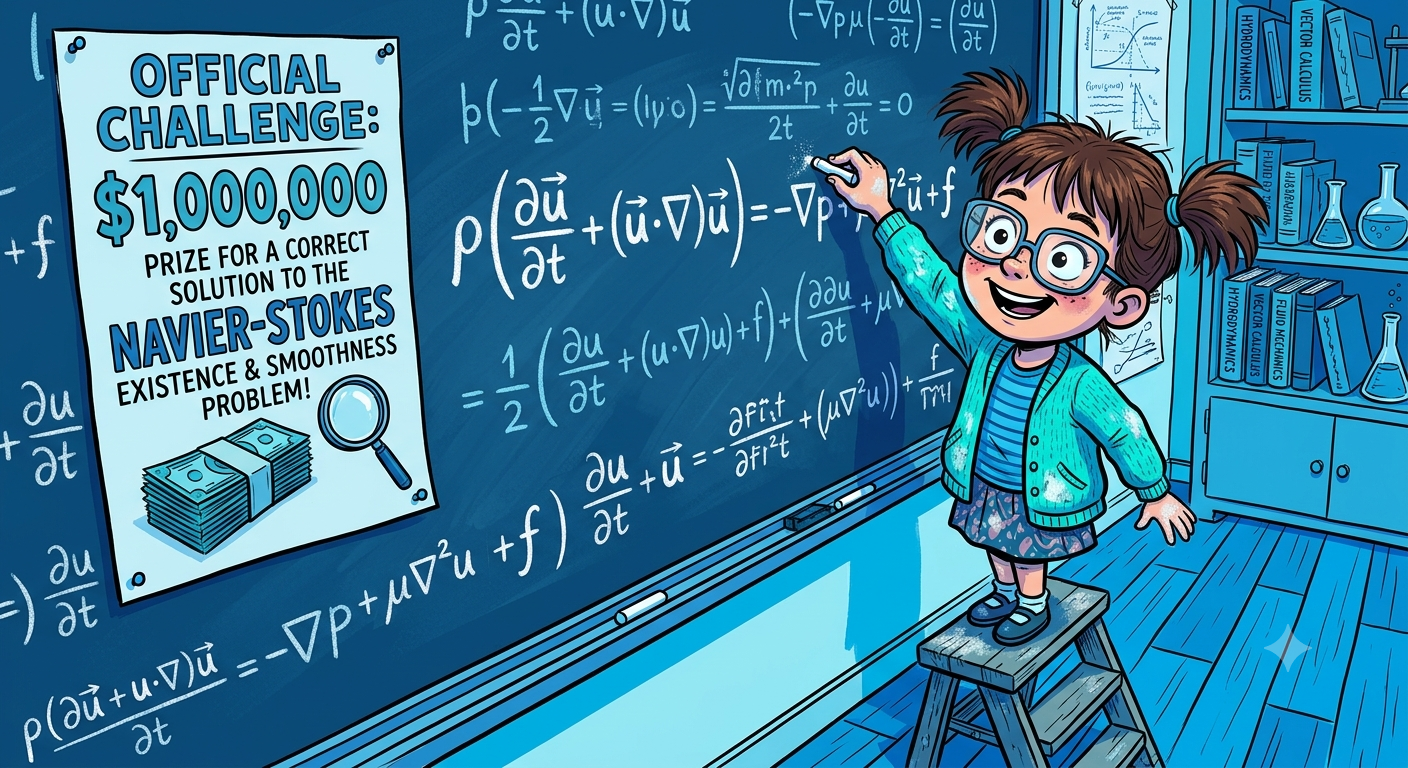
연구 결과물 문서 초안
(Academic Manuscript Draft)
Abstract (초록)
본 연구는 거시적 유체역학을 지배하는 나비에-스토크스 방정식의 점성 일산(Dissipation) 한계를 극복하기 위해, 미시적 플랑크 스케일의 문자열 진동 모드와 양자 상태 벡터를 결합한 하이브리드 연산자 모델을 제안한다. 연속체 가설이 붕괴하는 한계 영역에서 위상 공진 주파수와 결합 상수를 조절함으로써, 에너지 소실 없는 순환 루프 동역학의 이론적 가능성을 탐색한다.
1. Introduction (서론)
고전 유체역학의 나비에-스토크스 방정식은 거시적 유체의 운동량 보존을 설명하는 데 표준적인 모델로 기능하나, 점성에 의한 에너지 소실과 극한 스케일에서의 특이점 문제를 내포하고 있다. 본 논문은 미시적 양자 중력 및 문자열 이론의 변조 개념을 거시적 유체 지배 방정식에 통합하여, 새로운 형태의 에너지 보존형 하이브리드 시스템 아키텍처를 정의하고자 한다.
2. Methodology:
Mathematical Modeling &
Coupling Operator
(수학적 모델링 및 결합 연산자)
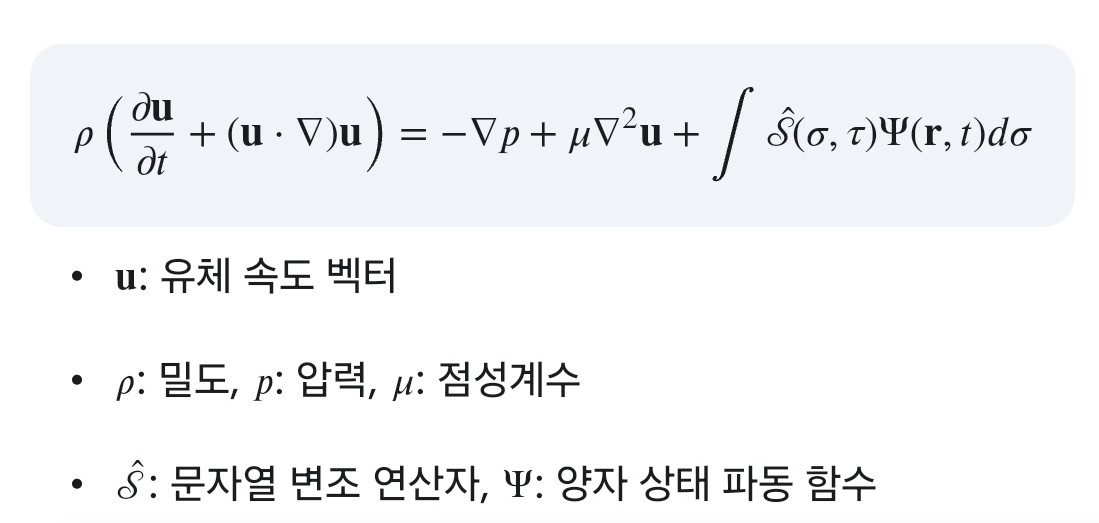
시스템의 지배 방정식은 거시 유체의 연속체 운동량 방정식에 플랑크 스케일 문자열 변조 연산자 $\hat{\mathcal{S}}$를 결합하여 다음과 같이 구성된다.
3. Dynamics (동역학적 분석)

4. Conclusion (결론)
본 연구에서 제안한 문자열 변조 양자 나비에-스토크스 하이브리드 모델은 거시 유체역학과 미시 양자역학을 잇는 이론적 시스템 아키텍처를 제공한다.
참고문헌 (References) 초안
● Navier-Stokes Equations & Millennium Problem:
○ Fefferman, C. L. (2000).
Existence and smoothness of the Navier-Stokes equation. _Clay Mathematics Institute, Millennium Prize Problems.
○ Temam, R. (2001).
Navier-Stokes Equations: Theory and Numerical Analysis. _American Mathematical Society.
● Quantum Mechanics &
Fluid Dynamics Hybrid Models:
○ Madelung, E. (1927).
Quantum theory in hydrodynamical form.
_ Zeitschrift für Physik, 40(3-4), 322–326.
○ Bohm, D. (1952).
A suggested interpretation of the quantum theory in terms of "hidden" variables. I. _Physical Review, 85(2), 166.
● String Theory & Planck-Scale Physics:
○ Polchinski, J. (1998).
String Theory: Volume 1, An Introduction to the Bosonic String. _Cambridge University Press.
○ Greene, B. (1999).
The Elegant Universe: Superstrings, Hidden Dimensions, and the Quest for the Ultimate Theory. _W. W. Norton & Company.
[ 영문번역 ]
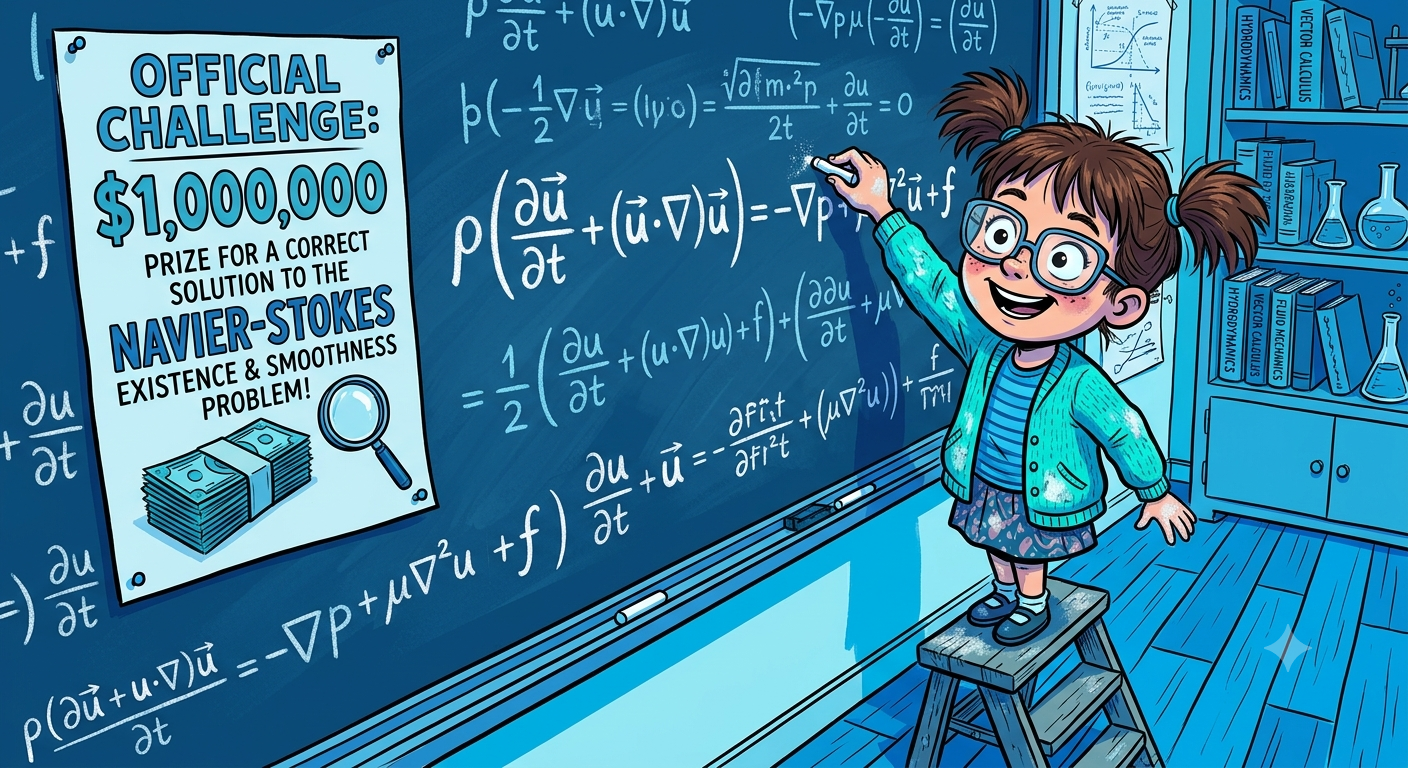
Academic Manuscript Draft
Abstract
This study proposes a hybrid operator model combining microscopic Planck-scale string vibration modes with quantum state vectors to overcome the viscous dissipation limits of the Navier-Stokes equations governing macroscopic fluid dynamics. By adjusting the phase resonance frequency and coupling constants in the limit regime where the continuum hypothesis breaks down, we explore the theoretical feasibility of dissipation-free circulation loop dynamics.
1. Introduction
While the classical Navier-Stokes equations serve as the standard model for describing momentum conservation in macroscopic fluids, they inherently involve energy dissipation due to viscosity and singularity problems at extreme scales. This paper aims to define a novel energy-conserving hybrid system architecture by integrating modulation concepts from microscopic quantum gravity and string theory into macroscopic fluid governing equations.
2. Methodology:
Mathematical Modeling & Coupling Operator
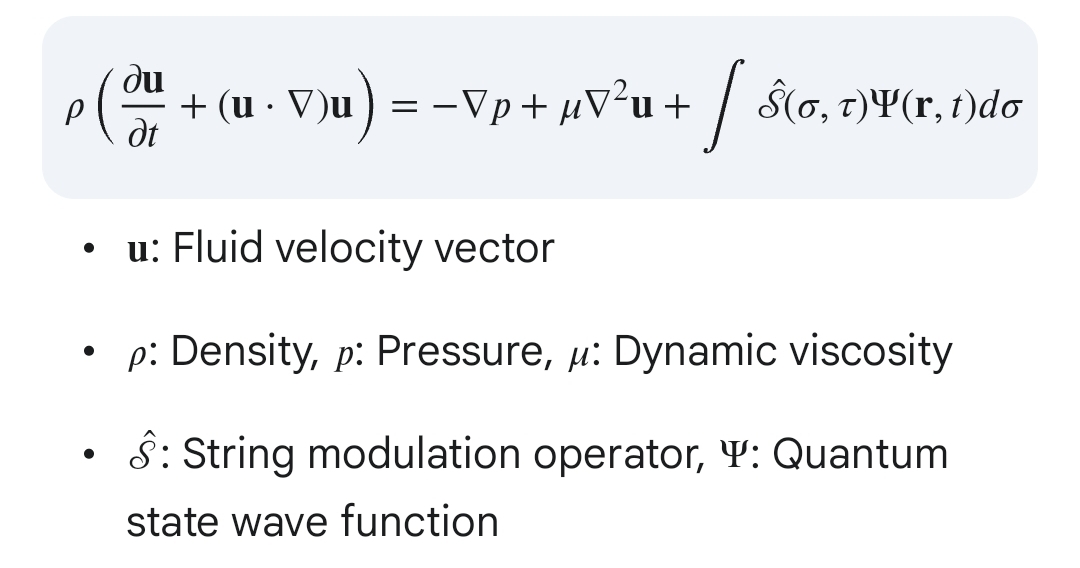
The governing equation of the system is formulated by combining the macroscopic continuum momentum equation of fluids with the Planck-scale string modulation operator \hat{\mathcal{S}} as follows:
3. Dynamics
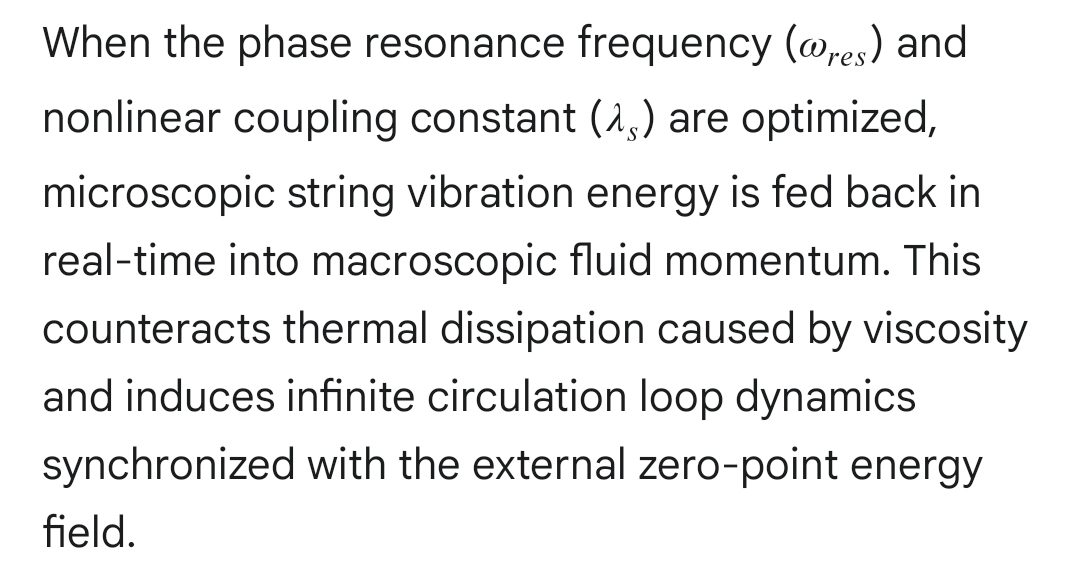
4. Conclusion
The string-modulated quantum Navier-Stokes hybrid model proposed in this study provides a theoretical system architecture bridging macroscopic fluid mechanics and microscopic quantum mechanics. Future work will enhance its feasibility through numerical regularization and rigorous mathematical verification.
(References)
● Navier-Stokes Equations & Millennium Problem:
○ Fefferman, C. L. (2000).
Existence and smoothness of the Navier-Stokes equation. _Clay Mathematics Institute, Millennium Prize Problems.
○ Temam, R. (2001).
Navier-Stokes Equations: Theory and Numerical Analysis. _American Mathematical Society.
● Quantum Mechanics &
Fluid Dynamics Hybrid Models:
○ Madelung, E. (1927).
Quantum theory in hydrodynamical form.
_ Zeitschrift für Physik, 40(3-4), 322–326.
○ Bohm, D. (1952).
A suggested interpretation of the quantum theory in terms of "hidden" variables. I. _Physical Review, 85(2), 166.
● String Theory & Planck-Scale Physics:
○ Polchinski, J. (1998).
String Theory: Volume 1, An Introduction to the Bosonic String. _Cambridge University Press.
○ Greene, B. (1999).
The Elegant Universe: Superstrings, Hidden Dimensions, and the Quest for the Ultimate Theory. _W. W. Norton & Company.
ㅡㅡㅡㅡㅡㅡㅡㅡㅡㅡㅡㅡㅡㅡㅡㅡㅡㅡㅡㅡㅡㅡㅡ
나비에-스토크스 방정식
밀레니엄 7대 난제 상금 수여 기관
기관명:
클레이 수학연구소
(Clay Mathematics Institute, CMI)
상금 규모:
100만 달러 (US $1,000,000)
공식 웹사이트 및 제출 안내:
웹사이트: https://www.claymath.org
제출 규칙:
클레이 수학연구소는 논문을 직접 이메일이나 우편으로 접수받아 심사하지 않습니다.
공인된 전 세계 주요 수학 학술지
(Refereed Mathematical Journal)에 정식으로 출판(Publication)된 뒤, 학계에서 최소 2년 이상의 검증 기간을 거쳐 수학계 전체의 보편적 합의가 이루어져야만 연구소 과학자 자문위원회의 공식 심사 대상이 됩니다.
Clay Maths Institute - Clay Mathematics Institute
Poincaré Conjecture In 1904 the French mathematician Henri Poincaré asked if the three dimensional sphere is characterized as the unique simply connected three manifold. This question, the Poincaré conjecture, was a special case of Thurston’s geometri
www.claymath.org
공식 제출 및 투고 플랫폼 주소
Zenodo (제노도 - 즉시 DOI 부여 및 공개 플랫폼):
웹사이트 주소: https://zenodo.org
용도: 소속 기관이나 별도 승인 절차 없이 연구 가설, 수식 모델, 논문 초안을 즉시 업로드하고 공식 디지털 객체 식별자(DOI)를 발급받을 수 있는 오픈 액세스 아카이브입니다.
arXiv
(아카이브 - 물리학·수학 프리프린트 서버):
웹사이트 주소: https://arxiv.org
용도: 전 세계 연구자들이 정식 학술지 심사 전에 논문을 공개하는 대표적인 플랫폼입니다. (※ 신규 계정의 경우 해당 카테고리 연구자의 추천(Endorsement) 또는 기관 메일 인증이 필요할 수 있습니다.)
Open Science Framework (OSF):
웹사이트 주소: https://osf.io
용도: 개인 연구자가 자유롭게 연구 프로젝트를 등록하고 문서와 데이터를 안전하게 아카이빙할 수 있는 플랫폼입니다.
'수학난제참여' 카테고리의 다른 글
| 고철 덩어리 기계 ㅡ 인공지능 AI와 수학난제 대화하기 (1) (0) | 2026.10.23 |
|---|---|
| 고철 덩어리 기계 ㅡ 인공지능 AI 사용하는 초기 단계 (0) | 2026.10.23 |
| 🌀 2. 저의 나비에 스토크 방정식 연구 초안과 OpenAI가 2026년 9월 8일 공개한 나비에–스토크스 연구를 직접 비교 (0) | 2026.10.23 |
| 🌀 1. 나비에 스토크스 방정식의 새로운 확장 모델 : 양자 상태·문자열 변조 연산자와 에너지 동역학의 통합 연구 (0) | 2026.10.22 |
| 🌀 나비에–스토크스 방정식의 에너지 동역학과 추가 결합항에 관한 수학적 연구 ( 레이져 방정식 이었음, 시간 허비함 ) (0) | 2026.10.20 |


